I've been on a morality/ethics kick for a while now, and I guess it's not really because I wanted to continue that old critique. There were a few things which happened recently that made me think about this stuff again. It all started when, for my Intro to Ethnic Studies class, I had to go out and find some place to observe people, writing down what I see and analyzing these observations to see what statements I can make about race relations, social behavior, etc. I went to the Farmer's Market, and my fiancee saw the anti-evolution thing that's there every week. She pointed out that they had both an American and Israeli flag on their stand, so we went to ask about that. This quickly became a discussion about religion, as they pretty much always make it about that, whatever it is you originally meant to talk to them about. But silly arguments aside, they mentioned once that Atheism doesn't give people any basis for morality. I agreed, and this just led us to saying things they didn't really grasp (like the idea that we can't know anything objectively. They really couldn't wrap their minds around that one, unless they simply misunderstood us completely).
Then my fiancee saw two people sitting at a table, giving information about a philosophy group. She was interested, and the next Thursday, we joined them (she used this group for a project she had to do for a class). There weren't many people there, but they had a very long discussion about how we determine value. While that sounds cool...it was pretty superficial. Not once did anyone question value itself, and ask whether or not things had value in the first place. Rather, it was basically just about why we value certain types of work, and certain types of objects, more than others and at different times. Pretty basic stuff. Going there just reminded me how I don't really have many people that I can talk to about deep philosophical things, and that most philosophy classes are just like this group (or, rather, worse than them).
At first, I just started thinking again about why we value things, and the fact that intrinsic value doesn't make sense...but then I was pulled back to what the anti-evolutionists were saying about morality. It's something that I feel Atheists try very hard to explain away, but I think it's something important to delve into. The basic argument is that morality without religion is free from obligation, and is something we do because it is right, instead of something we are told to do. But I think this is a bad argument, since it presumes that something is "right." This is one of the reasons why I think Atheism is, in fact, religion. It's kind of like Buddhism: there's no god, and it's not the same for everyone, but it still has "facts" that we can't explain without belief.
Now, I know that saying this will make Atheists angry. They don't like to be associated with such terms as "belief," "faith," and "religion." But if you are offended, I ask you to really think about what these terms mean. When I say that Atheism requires belief, I mean that it requires belief in "reality." You might not think of that as belief, but then you'd have to be able to prove that what we see around us is actually real. Which you can't. So you have to allow for belief. (For those who'll say that this is ridiculous, think about this: the brain can easily be fooled, and often is. How do we know, then, that everything in "reality" is not simply a misinterpretation of stimuli? Or that we have the kinds of brains we think we have? What if they work in a completely different way, which forces us to see this kind of "reality," in which our brains work this way instead? How do you know that the entire universe isn't all an illusion, a dream, etc.?)
Faith branches off of belief, but is less present in Atheism. Science, which most Atheists take as a founding principle, basically says that we should question everything, and determine whether things are true based on extensive tests of veracity. And even then, it allows for the idea that we might be wrong. But this system implies faith in the scientific method, in reasoning, and in logic. It is entirely possible that the universe is not governed by any logical laws. Perhaps what we witness is just random, or perhaps the universe changes based on our observation of it, only following laws when those who think laws must exist are near.
And religion basically comes from the combo of those two. The religion of Atheism says that there are no gods, and the universe can be explained purely by natural processes. Since there is no way of knowing if this is true, we can't see this statement as anything but a statement of belief. True, there are some who aren't this strict about things, but I would argue that they are not Atheists. Those who are on the side of uncertainty, and know that it is impossible to know anything, are Agnostic. There's a lot of confusion about terms, but I propose that the designation Agnostic Atheist be abolished, as well as Gnostic Atheist. A better, less confusing way of describing these things would be to change Gnostic Atheist to Atheist, and Agnostic Atheist to Agnostic.
(As for science, I want to clear something up: science, in and of itself, is not a religion or faith-based system. Gnostic Atheism, which uses science, is. Science is just the search for truth--it doesn't state that anything is true. Rather, it mostly gives guidelines for proving something false. The core of science is the endeavor of learning all there is to learn about the universe and everything, while being humble enough to realize that we can be wrong about the answer we come up with. If all of our "progress" in science up to this point were to be proven wrong, that wouldn't be a problem for science, since it doesn't depend on the veracity of its theories. But if a god appeared and showed that he was the one behind what we thought were natural processes, then Gnostic Atheism would be proven entirely wrong. So science goes best with Agnostic Atheism, but is not the exclusive method of either.)
But I digress. Atheism, as I have just defined it, presumes that something is "right." This is a belief, and because they believe that certain principles are right, then it can be argued that they do have a basis for morality. For most Atheists, this basis is reason. It's Agnostics who don't have a basis, since they have no concrete "right" and "wrong" to cling to.
The question I have, though, goes beyond this little semantics problem I brought up. What I have to wonder is...why should it matter? The anti-evolutionists made a point that there is no basis for morality in Atheism. And a lot of people make this point. But why is this relevant? Does the truth require morals? Is morality something we know to be true, regardless of which religion it comes from? No, of course not. Atheism can be right whether or not morals are part of the equation. Morality shouldn't be a prerequisite.
It's entirely possible that morality is just something we came up with, because humans (and some other animals) have an inclination towards fairness. That doesn't mean fairness is necessarily "right." I have an inclination towards reading, but that doesn't mean it is "right" for me to read. People have an inclination towards watching sports, but that doesn't make that "right." Anything we do is simply what we do, and does not necessarily become what we "should" do just because most of us have an inclination towards doing that thing.
So if someone kills another person, and we feel bad about it, that doesn't necessarily make it "wrong." If someone kills the entire human race, and our "progress" comes to an end, that isn't necessarily "wrong." If a comet hits a planet, that's not "wrong." If a star goes supernova, that isn't "wrong." Why should our actions be considered "right" or "wrong," when they are merely things which happen in the universe? This is how I, an Agnostic and Subjectivist, see morality. There is no basis for morality without an objective standard that is either observable or mandated. And when you look at it this way, morals based on reason seem empty.
You can read my last post to see what I think about morals derived from reason alone, which is what a lot of Atheists would be into. The basis for morality for most Atheists and Agnostics is either function (based on living in society), instinct (just being nice because you feel you should), or both. The distinction I would make is that there are two bases for morality: one for what you think should be done, and one for what you actually practice. For the first, I have no basis, because I believe nothing. But for the second, my basis for morality is a combination of function and instinct. I don't believe that the morals I act upon are "right" or "wrong," but I live by them anyway because they work for me, and they feel good.
The more I think about it, the more I sound hypocritical. I think there is a major difference, though, in the way I approach morality and the way most people do. There must be a difference somewhere in there between choosing a moral code to live by...and living to find out that what you do is close to a moral code someone else thought up through reason. After all, I'm not doing this out of any feeling that it is right or wrong, or that reason demands I do it. I just do it. I'm sure someone could argue that I'm working off of a reason-based ethic, but I realize that reason won't always lead one to a single moral theory. I realize that an objective moral standard could actually exist. Function, unlike reason, just means that I do what works so that I can survive. It's something that benefits from reasoning, but they aren't the same thing. So...unless someone can tell me why I'm wrong in saying this, I think I am not a hypocrite.
I think that if there's one thing we can take away from this, it's that one must first define what a basis for morality would have to be. If we go by "what we should do," then it is arguable that neither Atheists nor Agnostics have a basis for morality. If, however, we go by "what we actually practice," then it is clear that almost everyone, Atheist, Agnostic, or even theistic, has a basis for morality in function and instinct. You can say that Atheists and Agnostics don't have a basis for believing moral value, but it is completely ignorant to say that they have no basis for acting in a moral way.
Showing posts with label Religion. Show all posts
Showing posts with label Religion. Show all posts
October 26, 2013

August 27, 2013
Indoctrination
Recently, I've been watching some Jaclyn Glenn videos on YouTube. If you've never seen her stuff, I would suggest taking a look at some of them (http://www.youtube.com/user/JaclynGlenn). She's pretty interesting, especially since she used to be Christian, and still keeps up her videos from that time in her life so people can see the transition she made. Having changed from Christian to Agnostic myself, I liked seeing the drastic change as it reminded me of my own. What I wanted to focus on with this post, though, is something which she mentions a few times in her videos: religious indoctrination of children.
This is a topic very near and dear to my heart, since I was raised Christian and feel like that upbringing really messed me up for quite a while. Sure, I learned a lot about Christianity that helps me today, but it made me so judgmental, so arrogant, and so stubborn in the process. Becoming Agnostic was the best thing that ever happened to me, because it freed me up to really consider other possibilities and be tolerant of every belief system.
Even when I was a Christian, I thought that maybe it was a bad thing that kids were being taught a religion from the beginning. I read and loved C. S. Lewis's Chronicles of Narnia and, as those who have read The Last Battle know, Lewis included a bit at the end about a soldier from the Satan-worshipping army. The main characters run into him in heaven, and he tells them about how even though he didn't believe in the true god in name, he believed in the proper values, and saw his own god, Tash, as being the same way as Aslan. Thus, he truly was a believer of Aslan instead, and despite being brought up to believe that Tash was the good one, he was accepted into heaven.
I really liked this universal notion, that anyone could be accepted. But it really got me thinking...if Christianity was true, and non-universal ideas were true, then people who didn't believe in the true faith would go to hell. What if they were taught that Christianity was wrong, though? Christian parents teach their children that other faiths are wrong, so it only makes sense that other faiths would teach children that Christianity is wrong. And most religions have very similar values!
It came to me then that perhaps parents shouldn't teach children religion. First, it might make them turn away from the religion they are taught if they have a bad relationship with the parent. But more importantly, it makes them shut out any other faith, and look down on those who believe them. Children are very impressionable, so if you tell them that your faith is the right one, they will believe you. Or they will think that if they don't believe it, you won't love them. Or some other connection like that.
In this country, we see another problem: by making children believe a faith, we generally make them less inquisitive. If it's all solved from the start, they won't question anything. Give them the answer to life, the universe and everything from day one, and they don't spend anymore time thinking about it. And what's worse, they usually don't even care to fully understand the answer you give them. In the US especially, so many people don't even know very much about the religion they profess, let alone what other people believe. And understanding religion is a very important thing, with such a globalized society as ours.
Blind faith doesn't help anyone. A lot of people just accept that God exists, that homosexuality is wrong, that people of other faiths are awful, etc. True, not all religious people are this way, and I am very thankful for the exceptions. I appreciate seeing people like that, because it gives me hope that religion doesn't have to divide people. But there is still a huge social dilemma.
This is a topic very near and dear to my heart, since I was raised Christian and feel like that upbringing really messed me up for quite a while. Sure, I learned a lot about Christianity that helps me today, but it made me so judgmental, so arrogant, and so stubborn in the process. Becoming Agnostic was the best thing that ever happened to me, because it freed me up to really consider other possibilities and be tolerant of every belief system.
Even when I was a Christian, I thought that maybe it was a bad thing that kids were being taught a religion from the beginning. I read and loved C. S. Lewis's Chronicles of Narnia and, as those who have read The Last Battle know, Lewis included a bit at the end about a soldier from the Satan-worshipping army. The main characters run into him in heaven, and he tells them about how even though he didn't believe in the true god in name, he believed in the proper values, and saw his own god, Tash, as being the same way as Aslan. Thus, he truly was a believer of Aslan instead, and despite being brought up to believe that Tash was the good one, he was accepted into heaven.
I really liked this universal notion, that anyone could be accepted. But it really got me thinking...if Christianity was true, and non-universal ideas were true, then people who didn't believe in the true faith would go to hell. What if they were taught that Christianity was wrong, though? Christian parents teach their children that other faiths are wrong, so it only makes sense that other faiths would teach children that Christianity is wrong. And most religions have very similar values!
It came to me then that perhaps parents shouldn't teach children religion. First, it might make them turn away from the religion they are taught if they have a bad relationship with the parent. But more importantly, it makes them shut out any other faith, and look down on those who believe them. Children are very impressionable, so if you tell them that your faith is the right one, they will believe you. Or they will think that if they don't believe it, you won't love them. Or some other connection like that.
In this country, we see another problem: by making children believe a faith, we generally make them less inquisitive. If it's all solved from the start, they won't question anything. Give them the answer to life, the universe and everything from day one, and they don't spend anymore time thinking about it. And what's worse, they usually don't even care to fully understand the answer you give them. In the US especially, so many people don't even know very much about the religion they profess, let alone what other people believe. And understanding religion is a very important thing, with such a globalized society as ours.
Blind faith doesn't help anyone. A lot of people just accept that God exists, that homosexuality is wrong, that people of other faiths are awful, etc. True, not all religious people are this way, and I am very thankful for the exceptions. I appreciate seeing people like that, because it gives me hope that religion doesn't have to divide people. But there is still a huge social dilemma.
In very important places in the world today, the government is influenced--if not controlled--by religion. In the US, a country founded on religious freedom and the separation of church and state, the Christian Right is still making it hard to pass legislation that goes against any "traditional Christian values." Most of these values seem, to me at least, to be exactly the opposite of what the religion teaches. Yet, if people try to go against them, they point out religious/Biblical reasons for their viewpoints. Even where they do line up with the faith they profess, they do it in such a way that it doesn't foster peace or goodwill.
Worse, the public is generally Christian, and so most people won't vote for someone who isn't also a Christian. This is discrimination, and it needs to stop. It's great that we got a half-black president and are seriously considering a female president. But I won't think we've made real progress until we either have or seriously consider a Muslim president, a Jewish president, a Buddhist president, or, most of all, an Atheist or Agnostic president. (Mormon doesn't count, since it's still Christianity.)
Of course, with so many people being indoctrinated from an early age, it's very unlikely that this will occur for a long time. I don't expect to ever see it. I would be ecstatic if I did. With such a big hurdle as this, I see very few solutions other than time. But I thought up one anyway.
My idea--and please only think of it as one, since I know there are some problems with it--is to simply not teach children a religion. If you believe in something, don't tell your kid that what you believe is 100% correct. Instead, teach them about the multitude of beliefs out there. And if you don't know enough about them, at least tell them that different viewpoints exist, and that no one knows who is right for sure. DO NOT make your belief sound better. Rather, do your best to make them realize that all faiths are just as likely to be true.
How will this help? Simple: instead of having a religion stewing in their minds ages before they can actually understand it, treating your children this way will give them the chance to decide for themselves what religion to follow, or whether to follow one at all. Doing this for your children will show that you respect them enough to choose what they believe. Philosophically speaking, that choice is the most important choice anyone can make. And, hopefully, this plan of action will lead to religious people who don't rely on dogma, and have a much greater appreciation for other faiths.
Now, as for the practical side of things... This solution might be good for the US and its Christians, but what about Jews? Their religion is tied up in their heritage, so it would be awful if they couldn't share that, right? Though I guess my plan doesn't entirely leave them out: they can teach their children that this is their heritage, but that they can choose another faith and still be part of the Jewish people. I'm not sure how many Jews would be happy with that, though. And what about Muslim countries, where the state itself is controlled by religion? Well, that's a very hard nut to crack, since Islam is pretty strict about people not leaving the faith once they've joined. But I'm sure that this could be seen as a boon to them: it gives the child the decision to be Muslim or not, instead of indoctrinating them from the start. So if they decide not to be Muslim, it won't be a big deal, because they won't already be Muslim. Another issue is traditional rituals completed before children can possibly decide if they want them done. That's a huge snag, and leads into many different avenues I won't explore here for brevity's sake (baptism, circumcision, dedication, etc.). For these, assume that they are either abolished or allowed with the understanding that they are not binding. This would have to be worked out with each religion individually, and of course many people won't accept it based on this alone.
And it comes with some other practical things to work on. First, there would need to be religion classes in all schools, and much earlier on. I'm thinking about having all schools--public and private--be made to teach world religions at least around sixth grade, if not earlier. Second, there should probably be some sort of age limit to when you can pick a religion. I don't think this necessarily needs to be a strict, mandated thing, but it would help with Muslim countries as described above, and perhaps with the Jewish heritage problem. Third, there is the problem of children who die before they can choose a religion. For these, you should just treat them as Agnostics, unless they were leaning towards one religion at the time. This could potentially ruin my plan, since many parents want their kids to go to heaven. But, by universal philosophy, they should still be allowed that, given that they are good enough people before they die, or get some kind of divine mercy. Fourth, there will of course be corruption in this system (teachers who feel it is their duty to teach their own faith, people who don't follow the rules, etc.), but there already is corruption in every system, so that's not a huge deal. The whole point of this is to make it into a social norm, after all.
Hopefully, doing this will lead to a world in which religious people believe things not because they have been taught to believe them, but because that belief system makes sense to them. Because it works for them. Because it feels right to them. And with that, people should be less intolerant, because they realize that everyone out there had the same decision in front of them, the same arguments for every side, and the same doubts. Does this mean there will be less religious people in the end? Most likely. But it probably won't go away, and the study of religion will not disappear either. Those who are religious will just be less hateful than they currently are.
The big problem I have with this plan is this: it's biased in favor of Agnosticism. Obviously an Agnostic would come up with a plan that basically makes all children Agnostic! I mean, at least Agnosticism isn't really a concrete belief, though. Rather, Agnosticism is the absence of belief. So it might be indoctrination, but all teaching of children is indoctrination. What this does is provide the least indoctrination possible. Justify it all I might, though, I feel like it's probably not the best plan. There are enough problems with it, that I freely admit, for it to be accepted by anyone but Agnostics and the more liberal people of each faith.
What do you guys think? Are there any problems I missed? (I'm sure there are.) Do you think it would be a good idea?
My idea--and please only think of it as one, since I know there are some problems with it--is to simply not teach children a religion. If you believe in something, don't tell your kid that what you believe is 100% correct. Instead, teach them about the multitude of beliefs out there. And if you don't know enough about them, at least tell them that different viewpoints exist, and that no one knows who is right for sure. DO NOT make your belief sound better. Rather, do your best to make them realize that all faiths are just as likely to be true.
How will this help? Simple: instead of having a religion stewing in their minds ages before they can actually understand it, treating your children this way will give them the chance to decide for themselves what religion to follow, or whether to follow one at all. Doing this for your children will show that you respect them enough to choose what they believe. Philosophically speaking, that choice is the most important choice anyone can make. And, hopefully, this plan of action will lead to religious people who don't rely on dogma, and have a much greater appreciation for other faiths.
Now, as for the practical side of things... This solution might be good for the US and its Christians, but what about Jews? Their religion is tied up in their heritage, so it would be awful if they couldn't share that, right? Though I guess my plan doesn't entirely leave them out: they can teach their children that this is their heritage, but that they can choose another faith and still be part of the Jewish people. I'm not sure how many Jews would be happy with that, though. And what about Muslim countries, where the state itself is controlled by religion? Well, that's a very hard nut to crack, since Islam is pretty strict about people not leaving the faith once they've joined. But I'm sure that this could be seen as a boon to them: it gives the child the decision to be Muslim or not, instead of indoctrinating them from the start. So if they decide not to be Muslim, it won't be a big deal, because they won't already be Muslim. Another issue is traditional rituals completed before children can possibly decide if they want them done. That's a huge snag, and leads into many different avenues I won't explore here for brevity's sake (baptism, circumcision, dedication, etc.). For these, assume that they are either abolished or allowed with the understanding that they are not binding. This would have to be worked out with each religion individually, and of course many people won't accept it based on this alone.
And it comes with some other practical things to work on. First, there would need to be religion classes in all schools, and much earlier on. I'm thinking about having all schools--public and private--be made to teach world religions at least around sixth grade, if not earlier. Second, there should probably be some sort of age limit to when you can pick a religion. I don't think this necessarily needs to be a strict, mandated thing, but it would help with Muslim countries as described above, and perhaps with the Jewish heritage problem. Third, there is the problem of children who die before they can choose a religion. For these, you should just treat them as Agnostics, unless they were leaning towards one religion at the time. This could potentially ruin my plan, since many parents want their kids to go to heaven. But, by universal philosophy, they should still be allowed that, given that they are good enough people before they die, or get some kind of divine mercy. Fourth, there will of course be corruption in this system (teachers who feel it is their duty to teach their own faith, people who don't follow the rules, etc.), but there already is corruption in every system, so that's not a huge deal. The whole point of this is to make it into a social norm, after all.
Hopefully, doing this will lead to a world in which religious people believe things not because they have been taught to believe them, but because that belief system makes sense to them. Because it works for them. Because it feels right to them. And with that, people should be less intolerant, because they realize that everyone out there had the same decision in front of them, the same arguments for every side, and the same doubts. Does this mean there will be less religious people in the end? Most likely. But it probably won't go away, and the study of religion will not disappear either. Those who are religious will just be less hateful than they currently are.
The big problem I have with this plan is this: it's biased in favor of Agnosticism. Obviously an Agnostic would come up with a plan that basically makes all children Agnostic! I mean, at least Agnosticism isn't really a concrete belief, though. Rather, Agnosticism is the absence of belief. So it might be indoctrination, but all teaching of children is indoctrination. What this does is provide the least indoctrination possible. Justify it all I might, though, I feel like it's probably not the best plan. There are enough problems with it, that I freely admit, for it to be accepted by anyone but Agnostics and the more liberal people of each faith.
What do you guys think? Are there any problems I missed? (I'm sure there are.) Do you think it would be a good idea?
May 9, 2013
Living Buddha, Living Christ
 Living Buddha, Living Christ, by Thich Nhat Hanh, is the book we had to read for my religion class so we could reflect on it and discuss the ideas within. It was kind of pointless, since we didn't get to talk about East Asian religions as much, and we completely skipped New Age religions all so we could get a start on a book about connecting ideas of Christianity and Buddhism. The author of the book is a very engaged Buddhist, trying to facilitate discourse between faiths.
While most of my annoyance with the book is just because of its placement into the course, there are still some things that bother me about the text. For one thing, my teacher pointed out that Hanh gets Christianity wrong on a few occasions, applying too much Buddhist ideology to them. But that I can overlook, since I think people should be allowed to believe in whatever they want to anyway, so being picky about that is kind of contrary to his point.
What bothers me is the repetition, first of all, since I had to do reflections on different sections and found myself repeating things. But even that's okay, since he's trying to point out the nuances of the things. The worst part for me, though, was when he blatantly said that people who don't have a spiritual root/center "suffer tremendously." That, in my opinion, is a statement that can be true, but is definitely not always the case. If by suffering he means physicality, then people suffer regardless of spirituality. If he means spiritually, however, he is just plain wrong in making that blanket statement. There are many people in this world who are Atheists or Agnostics and happy. Successful. Smart. Joyful. And even moral. I, personally, am an Agnostic who suffers just as much as anyone with a spiritual root and/or center.
Of course, there are other ways of looking at what he means by that. He could just mean something more like a moral center, in which case yes, people without that tend to suffer because others see them as evil, and social karma comes back to haunt them. Or it could be a really ambiguous root/center, just meaning that you need to have something there, be it religion, morality or love, etc. In which case, maybe. I could say I have a spiritual root/center if that's what he means, since I act according to certain principles and have a sense of there being something "right" to do. But I specifically try not to put that at the center because that would make it absolute, which goes against my philosophy of tolerance for contrary facts and opinions.
Other than that, I'd say this book has some good insights, especially for anyone involved in organized religion. I think there should be more dialogue between faiths, and I hope that increasing this will result in more tolerance all around, though I doubt it will really lead to anything meaningful in my lifetime.
Rating: 3.9/10
April 26, 2013
Tao Te Ching
 In my religion class, we read a few parts of Lao Tzu's Tao Te Ching, and learning about Taoism interested me very much. I decided that I would read the entire book, and so I got the 1988 Stephen Mitchell translation from the library. I was already thinking that I wanted to read another religious text (I've already read the entire Bible, and learning about religions has made me curious to read other texts), so this fit well, and it was something I could read even in my tight schedule.
The Tao Te Ching is a great book, full of some wonderful insights into the way the world works and how, through wu-wei (doing not-doing, acting inaction, going with the flow, etc.), we can live in such a way that we bring about harmony in the world. It's really not something that can be easily explained in a few sentences, but rather something that needs to be read, experienced, and studied on one's own.
That being said, maybe this translation isn't the best to do that with. Reading the notes to each poem, I was shocked to see Mitchell admit that he had "interpolated" and "improvised" some of the stanzas in the book. I felt like this was a bad thing for a translator to do. I can understand wanting to make a book that the non-Chinese public will find more accessible, but to be honest I couldn't see why he changed the ones he did (especially since he provides the "original text" for these in his notes: why not just put those in, and explain them in the notes instead?). I don't really know what the best translation is, but I figure that I'll just read from different ones to get a better sense of what the words are supposed to be.
Rating: 6.3/10
Reading some of them reinforced a lot of the ideas that I have about the world. For one, there was a common theme of letting go of possessions, and not putting so much importance on material things. After all, if you treasure something, then it is more likely that people will try to steal it. It's a very different philosophy from that of America, which is why it was so refreshing for me. After a semester of Environmental Lit. showing me how our culture is ruining the earth and destroying humanity itself, it was nice to see that someone once thought about these things.
If you call something good, then you create evil. If you are saying that it is good, then you are implying that there is a quality called not-good to compare it with. This idea made me think about the paradox of God creating good and evil--if all he creates is good, why is there evil? Well, he actually calls things "good!" Evil didn't rise because he created that explicitly, but because it is a natural byproduct of goodness: by creating good, he created the possibility of evil.
There are tons of things like that in the book, and I don't think I could possibly summarize it all in a way that would satisfy me. Instead, I'll just recommend that everyone read this book and really think about what it says. Here's a site with some different translations:
http://duhtao.com/translations.html
April 11, 2013
Galileo Goes to Jail and Other Myths about Science and Religion
 Another book for school, but this time it's one for my science class. This book, like the title suggests, is about numerous myths surrounding the link between science and religion. Some of them are pretty broad, such as ones concerning the effect of Christianity on the birth of science, how Islam reacted to the influence of science, and how science hasn't necessarily secularized Western culture. But there are also some really interesting ones, such as the one it mentions on its cover (it is very likely that Galileo never spent a night in an actual jail because of that trial--and there is no evidence suggesting that he was ever tortured).
A lot of the myths are simply cases where the media or certain people have exaggerated things, and so the myth is loosely true. And that did annoy me sometimes. But overall, it did open my eyes to some cool facts about the history of science. I would definitely recommend this book to anyone and everyone, if only so these myths could finally die.
Rating: 7.4/10
February 28, 2013
Siddhartha
 I just finished reading Siddhartha, by Hermann Hesse. Since I'm taking a class on religion (Religious and Spiritual Traditions of the World), reading more religious books seems almost natural--hence The Gospel of the Flying Spaghetti Monster. But it's also because my mom started me on this path by giving me Walk On for Christmas. It's a book about "the spiritual journey of U2." I used to be a huge U2 fan, and my mom likes to try and connect to me through that, even though I don't think quite so highly of them as I used to. But I guess I could go even further and say that this all started when I read Life of Pi last year, and was both intrigued and annoyed by the way religion was used in that novel.
Anyway, we were about to start our section on Hinduism in my class, and it looked like I would have time to read something I actually wanted to for once, so I decided to read Siddhartha. (I was thinking about buying it once, when I got The Canterbury Tales and considered doing Barnes and Noble's Buy 2 Get 1 Free deal, but I figured I should read it first. Plus, when I was trying to think of a random book to mention in a short story I was mapping out, Siddhartha was the first to come to mind. So it felt like this book was calling to me.)
It's a lot shorter than I thought it would be. Plus, the writing style is very simple, almost like that found in fairy/folktales, with just the essentials of the story, and usually very plain dialogue. At first I was disappointed by this, feeling like it was more of a short story than a novel. But as I continued reading, I felt like this writing style was actually good for this kind of story. The story itself was pretty good. It's basically the life of a Brahmin who leaves home to go on a pilgrimage, seeking truth, enlightenment, and above all, peace. He continually shifts from one path to the next, not letting himself get tied down in dogma or the silly concerns of normal people (not for too long, anyway). It's a story of the yearning for meaning in life.
The philosophical and religious aspect of it was interesting, especially since I was reading about Hinduism for class already, so I grasped all of the concepts touched on in the book (like the fact that Siddhartha was from the tradition that followed Shankara's teachings, made blatant by his reference to Maya, the confusion caused by material reality that stops us from realizing the fact that everything is connected). It really stressed, for me, the fact that Hinduism is so varied and so open-minded that Siddhartha was allowed to break way from one tradition after another in search of his own truth...something which most other major religions would frown upon. No one in the book said that Buddha was wrong, even though his teachings were pointedly breaking away from Hinduism. Likewise, no one stopped Siddhartha from going on his way (his father took a while to approve it at first, but this was mostly because he didn't want to see his son leave him. And Govinda questions him a lot, but this is merely to understand Siddhartha, and perhaps learn something by questioning his choices).
Rating: 6.1/10
February 24, 2013
The Gospel of the Flying Spaghetti Monster (and some other religious talk)
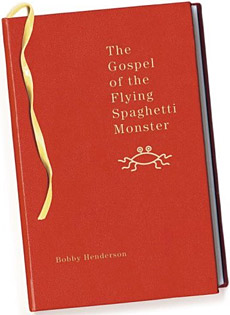
I recently decided to read The Gospel of the Flying Spaghetti Monster, by Bobby Henderson. While I am agnostic, I am inclined towards atheism, and the parody implied by this book intrigued me. I liked the idea of pointing out that the FSM is just as ridiculous, and as valid, as any other revered deity. So I went into this book expecting to see a spoof of a religious text, with every part of it being similar to other texts in some way, creating a myth that is ridiculous, in the same way that other world myths are to those outside of the culture.
But I was disappointed. Most of the book was written by "experts" trying to prove the religion by stupid arguments, most of which only the most amateur of apologists would use. Some portions were repeats of other parts, which was annoying (the graph for the effect of Pirates on average global temperature was used about 5 times). If anything, the book serves as one of those weird treatises by religious fanatics that no one from the religion really wants to own up to.
There were some good parts, though. I won't give them all away, for those who actually want to read it, but there were some clever connections made between reality and the effects of a god made of pasta. After a while, though, the points about that started getting tiresome. So it's fun for a while, but it really drags towards the end. I would've enjoyed it more if it had been shorter, or if it included some excerpts from a fake religious text (which would have been good for Henderson market-wise, since he could've written another book--one which would've been exactly what I'd been hoping this one would be).
I give this one 3.3/10.
This book also made me think about my religious stance a little, and how I feel about atheists. In my sophomore year at high school, I read Science and the Supernatural, a series of letters between a Catholic and an atheist. The latter pointed out that he was actually agnostic, although he was strongly against the existence of God. His distinction was that while he believed God didn't exist, he knew that it was impossible to know for sure, and that alone made him agnostic. This is something I struggle with. Once, my dad talked to me about a different form of agnosticism, which is simply not believing in anything at all (my current stance).
Of course, we always want to categorize things, so as I looked at some stuff about religion, I came upon the term Atheist Agnostic, which basically means not believing that a god exists, but knowing there is no proof. At first I thought I fit this category, since I have an atheistic inclination. But then I started thinking more about it. My aim is to be more objective, and so I feel bad for being so vehemently atheistic in my thoughts. Plus, there's a good amount of atheists who obnoxiously call all theists idiots (similar to the way a lot of theists tell others that they're going to hell). I don't want to be associated with this trend, and I really hope it goes away, along with all the rampant intolerance between other religions.
Another problem is that "agnostic" is used in religions sometimes to mean that someone believes in the general parts of a belief system, but isn't part of a certain denomination, or is unsure about certain parts of it. This gives people the idea that agnosticism is just a prefix or suffix that is added onto a religion to talk about personal uncertainty within a bigger picture. I don't really like this, since it creates my problem with the Atheist Agnostic label. I'm not an atheist; my agnosticism comes first. But Agnostic Atheist pretty much says the same thing (heck, maybe that's the better term for it). Should I say Atheistic Agnostic? Agnostic with a splash of Atheism?
So I much prefer the idea that I am Pure Agnostic. I don't believe in anything. I don't believe God exists; I don't believe God doesn't exist. I frankly just choose not to believe. Believing puts you in a position where you can't accept that other data could be true. While I think it's most likely that God doesn't exist, I know that it's impossible for me to know that for sure. But I'm not going to believe anything either way. I work under assumptions gained through inductive reasoning and probability, but I always realize that I can be wrong. Now, I'm not trying to convert anybody, but I think this is the best attitude for people to have, since it fosters tolerance for other beliefs and other ways of living.
And just for future reference...when I use the word "believe" in a sentence...know that I'm using it in a casual manner, just throwing it out there because it fits--not because I'm strict about the thing in question.
Subscribe to:
Posts (Atom)